
Japji Sahib for Kids — Read, Understand, and Remember
Japji Sahib is the Sikh morning prayer. Start with the Mool Mantar — its opening lines — then take one stanza at a time.
The Journey
Walk the path, one stanza at a time
Tap any open step to begin — no streaks, no pressure, at your child's pace.
How to learn Japji Sahib with your kids
A simple five-step rhythm you can repeat for every section — read, understand, learn the words, test, and color. Go at your child's pace; even one pauri a week adds up.
1. Read it together
Read the Gurmukhi out loud, then the easy transliteration. Hearing and seeing the words together helps them stick.
2. Understand the meaning
Talk about the simple English meaning. Ask your child what they think it means in their own words.
3. Learn the words
Use the word-by-word glossary to learn a few new Gurmukhi words at a time — the building blocks of the whole bani.
4. Test yourself
Take the short quiz for each section to check what you remember. Matching Gurmukhi words to meanings makes it fun.
5. Color and keep
Print the coloring sheet for each pauri. Coloring the outlined Gurmukhi is a calm, hands-on way to remember it.
Watch & recite the complete Japji Sahib
Follow along as each Gurmukhi word lights up in time with a slow, clear recitation — the complete paath, from Mool Mantar through all 38 pauris to the closing Salok, with easy transliteration and English meaning on screen. Every section is chaptered, so you can jump straight to the pauri you are practising.
Uses YouTube's privacy-enhanced mode — no cookies set until you press play.
Now available
Learn word by word with the Japji Sahib app
Our free app goes further than this page: every word of Japji Sahib highlighted as it is recited, tap any word to hear it on its own, and practice one pauri at a time at your own pace — for kids learning their first paath and adults refining their shudh ucharan. Read more about the app below, or press play on any line of a pauri page above to hear it recited slowly and clearly right now.
Color the whole Japji Sahib
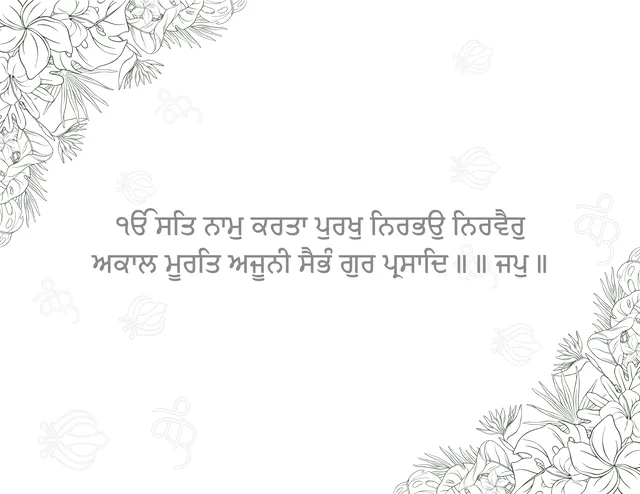
Each pauri comes as a free printable coloring sheet — the Gurmukhi drawn as outlined letters on a floral border, so children can color the bani themselves. A calm, screen-free way to spend time with the words and remember them.
Frequently asked questions
- What is Japji Sahib?
- Japji Sahib is the opening composition of Sri Guru Granth Sahib Ji, written by Guru Nanak Dev Ji. It begins with the Mool Mantar and is made up of 38 pauris (stanzas) framed by an opening and closing Salok. It is the first bani of the daily Nitnem and a foundation of Sikh prayer.
- How many pauris are in Japji Sahib?
- Japji Sahib has 38 pauris (stanzas). On this page the journey is shown as 41 steps — the Mool Mantar, the opening Salok (Aad Sach), all 38 pauris, and the closing Salok — so children can move through the whole paath one calm step at a time.
- How can this page help my child learn Japji Sahib?
- Each stanza is taught line by line — the Gurmukhi, an easy transliteration, and a simple English meaning, with a key-words list to build vocabulary. Every stanza also has a short word quiz and a printable coloring sheet, so children can read, understand, and remember at their own pace.
- When should you read Japji Sahib — in the morning or evening?
- Japji Sahib is a morning prayer. It is the first bani of the daily Nitnem and is traditionally recited in the amrit vela — the quiet hours before dawn — to begin the day. The evening and night Nitnem use different banis (Rehras Sahib at sunset and Kirtan Sohila before sleep), so within the daily prayer routine Japji Sahib belongs to the morning.
- Can you read Japji Sahib in the evening?
- Yes. Although Japji Sahib is part of the morning Nitnem, there is no restriction on reading or learning Gurbani at any time of day — reading it in the evening, or whenever you have a calm moment, is always beneficial. For a child who is just beginning, regular, unhurried practice matters far more than the exact hour.
- Is there a Japji Sahib paath for kids in plain English?
- Yes — this page is built as a gentle Japji Sahib paath for children. Every pauri shows the original Gurmukhi alongside an easy transliteration and a simple, child-friendly English meaning, so kids can follow the whole recitation, understand what it says, and slowly build towards reading it on their own.
- Are the Japji Sahib coloring sheets free?
- Yes — the per-pauri coloring sheets are free to download and print. Each one shows the Gurmukhi as outlined letters on a floral border so children can color the bani themselves. A complete bound coloring book covering all of Japji Sahib is also available.
- Is the English meaning accurate?
- The Gurmukhi text follows Sri Guru Granth Sahib Ji (Ang 1–8) and should be treated as the original Gurbani. The English is a simplified, child-friendly rendering of standard scholarly translations — a learning aid alongside, not a replacement for, reading the original bani.
One pauri a week, together
I write a weekly letter for Sikh parents whose kids don't live their day in Punjabi — small things to try this week, and new free printables as they land. No spam, no paywall.
Get them by emailFor parents & teachers · unsubscribe anytime
Keep learning
Learn Anand Sahib
Guru Amar Das Ji's song of bliss — the six pauris of daily Nitnem, short enough for a child to finish.
Ardas for Kids
The prayer that opens and closes every Sikh service — line by line, with the meaning under each one.
Learn Gurmukhi letters
Start with the 35 letters of the Gurmukhi alphabet — the script Japji Sahib is written in.
Gurmukhi tracing worksheets
Free printable tracing sheets to practise writing every Gurmukhi letter.
Punjabi picture dictionary
Build vocabulary with hundreds of everyday Punjabi words and pictures.