
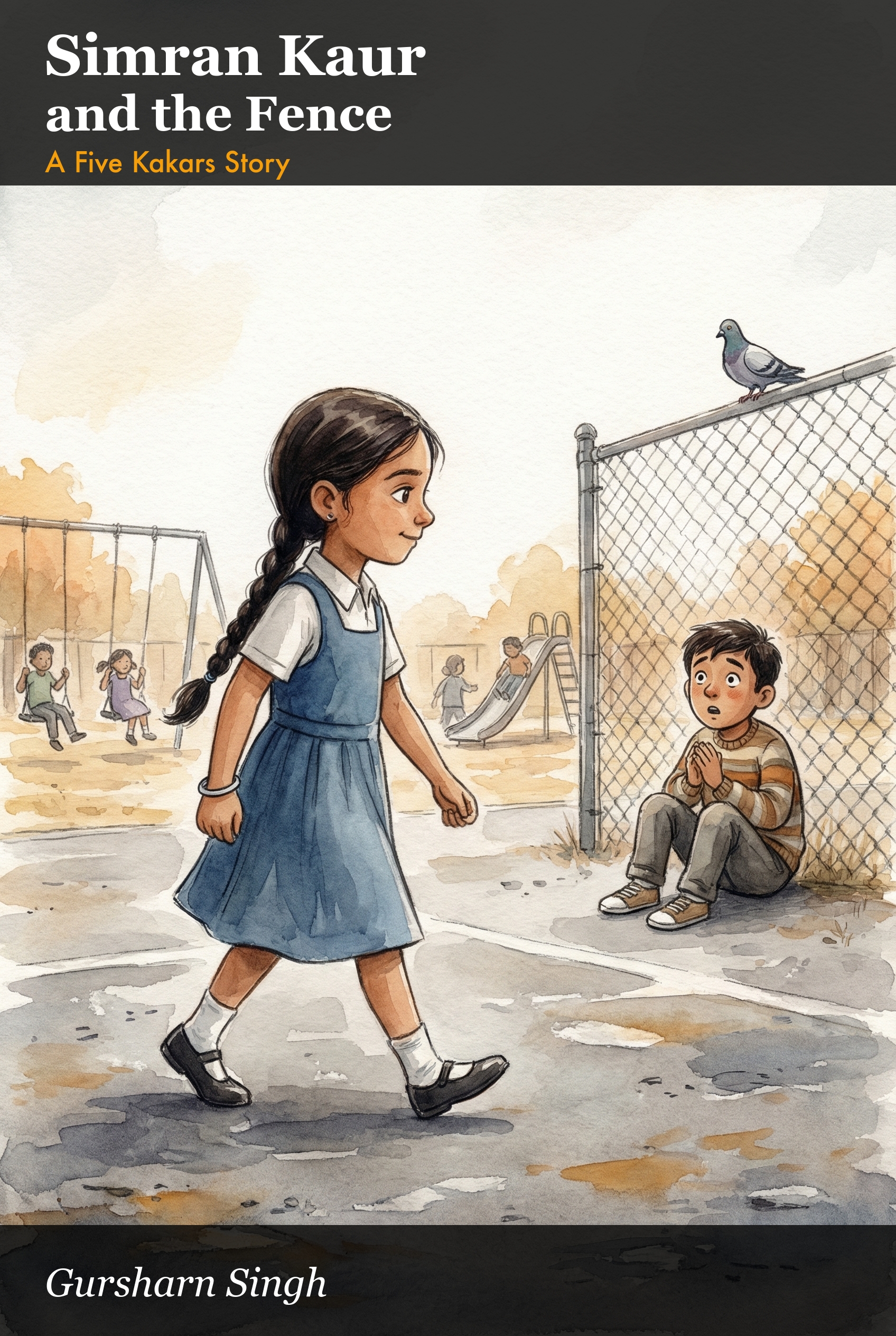
Quick Summary
Simran Kaur and the Fence is a free Sikh children’s story about the kirpan — the small blade that is one of the Five Kakars, and the one most often misunderstood. For three days running, Simran notices the same thing at recess: a new boy named Aiden, sitting alone at the chain-link fence while forty other children play. On the third day she sets out to go to him — and gets six steps before her nerve fails and she turns back.
The next day she counts ten steps instead, and sits down. She doesn’t ask him why he’s alone or tell him to come and play; she just stays. It turns out Aiden moved to Brampton only weeks ago and left his whole world behind — a best friend, a city, a recess that was never empty. That evening, Simran finally asks her dad to tell her properly about the kirpan he wears, and learns what its name truly means: kirpa (mercy) and aan (honour). She realises she carried the promise before she knew its name. It’s the fourth story in the Simran Kaur series, written for ages 4–12 and set in Brampton. Alongside the story you’ll find a printable coloring sheet — free.
Three Days
Simran Kaur counted thirty-two steps to the bus stop every morning.
She lived on Kennedy Road, in Springdale — the northeast part of Brampton where the streets were wide and the houses were brick with double driveways, and almost every household had at least one set of grandparents inside. On summer evenings the aunties walked the pavement in pairs, doing their sair in salwar suits and running shoes, up and down the same stretch before it got dark. In October it was too cold for that now, but the signs at the plaza down the block still had Gurmukhi alongside English, the way everything in Springdale did — two languages, one neighbourhood.
There were fourteen red doors between her house and the corner. She counted them the same way she counted everything — not because she doubted the number, but because doing it the same way each morning made a big, loud world feel like it would hold still long enough to be looked at. Thirty-two steps. Fourteen red doors. The dome of Gurdwara Dasmesh Darbar two blocks north, white against the October sky, just visible above the rooftops at the right angle.
She had counted these things since September. They were hers.
On Monday, she counted a boy she didn’t know, sitting by the fence at the edge of the playground. He had his back against the chain-link and his knees pulled up to his chest, while everyone else played. There were forty-one children at recess. The boy was the only one not moving.
On Tuesday, he was there again. Same spot. Same fence. Same knees. The soccer game roared past him. Two girls played hopscotch near the doors. The boy watched all of it the way you watch television in a language you don’t speak — like the sounds made sense but the pictures didn’t.
On Wednesday, he was there a third time. Someone sprinted past him chasing the ball, and he pulled his knees a little tighter. He had a drawstring bag beside him — green, with something round inside it that pressed the cloth into a curve. He never opened it. He just kept it close, the way you keep a thing that is the only piece of somewhere else you have left.
Three days. Same fence. Same boy. Same empty ring of asphalt around him.
At lunch, Simran sat with Maya and Ethan. Maya had her sketchbook open — she was working through every bird she’d spotted in October, one drawing per species, and she was up to seventeen. Today it was a crow, and she was very serious about the angle of the wing. Ethan had six straws and was building something architectural that kept almost standing up and then not.
“Who’s that boy by the fence?” Simran asked.
Maya looked up. “Aiden. He started last week. He’s in Ms. Park’s class.”
“He’s there every day,” said Simran.
Ethan glanced toward the window. “He probably likes it there. I like being on my own.”
“For three days running?”
Ethan didn’t answer. Maya’s crow stared up from the page with one careful eye.
Simran looked at Aiden through the glass. He didn’t look like someone who liked it there. He looked like someone waiting for a thing that kept not arriving. She had felt that once — a birthday party where she’d known nobody, a whole afternoon spent holding her breath — and she remembered exactly the shape of it.
On the 37 bus home that afternoon she counted traffic lights, fifteen between school and the gurdwara stop, the same as every day. Over the western rooftops a plane from Pearson banked low and slow, the white belly of it tipping into its descent. She found that comforting, usually — something large moving exactly the way it was meant to, on time, on course.
But she kept thinking about the boy at the fence, and the green bag he wouldn’t open, and how forty children had somewhere to be and one of them didn’t.
The Third Recess
On Wednesday afternoon, the lunch bell rang and Simran put on her coat. She had made a decision. She would go to the fence and sit next to him. She had been turning it over since lunch, and she had decided.
She stepped out onto the playground. It was louder than usual; the soccer game had already started. Maya had gone ahead to find a spot to draw. Ethan had peeled off toward the climbing structure.
Simran looked across the playground to the fence. Aiden was there. Same spot.
She started walking. One. Two. Three.
The soccer game was loud on her left. Someone yelled about the ball going out.
Four. Five.
She slowed.
What if he didn’t want anyone to sit there? What if he looked up, and then looked away? What if she sat down and couldn’t think of a single thing to say — not one sentence, not even a word — and they just sat in the silence while the whole playground moved around them, and she had to count the seconds until the bell saved them both?
She stopped.
She was maybe six steps away. She stood there with her coat zipped and her hands at her sides, looking at the back of Aiden’s coat.
Ethan ran up from behind. “Come to the climbing structure.”
“In a minute,” she said.
But she didn’t go to the fence. She turned around. She walked back toward the school — seven steps, eight, nine — through the door and into the warm, and sat down on the bench by the coat hooks.
Through the glass she could still see the playground. The fence. Aiden’s small shape against the chain-link, knees up, the green bag beside him. She counted the children who passed in front of him: four, five, six. None of them stopped.
Then she counted the steps she’d taken toward him. Five. Maybe six. And then she’d turned around — seven steps back. Twelve steps total, none of them adding up to anything at all.
She looked at her kara and turned it once on her wrist.
The bell rang. She stood up. She hadn’t walked past him, exactly. But she hadn’t gone, either. She didn’t know which one this counted as, and that bothered her more than a number that wouldn’t come out even.
The Kanga
The next morning, Simran sat at the kitchen table in her school clothes, eating toast. Her mum stood behind her, working the kanga through her hair in long, patient strokes.
Thirty-eight strokes. Always thirty-eight. Simran had started counting them when she was small, privately, never telling anyone — there was a warm certainty in knowing that thirty-eight was always thirty-eight, that the braid would always come out tight and even, that her mum’s hands were steady and sure.
“Sit still,” said her mum.
“I am sitting still.”
“You’re sitting still and fidgeting at the same time. Different things.”
Simran flattened her hands on the table. Outside, the maple had lost most of its leaves — six left on the lowest branch, bright yellow against the grey.
“Maa,” she said. “If you saw someone sitting on their own every day, what would you do?”
Her mum’s hands paused for just a moment, then went on. “Who are we talking about?”
“Nobody. I’m just asking.”
“Mm.” Three more strokes. “I’d think about it for a while, probably.”
“And then?”
“And then I’d go and sit next to them.” The braid began, her fingers quick and even. “You don’t always have to say anything. Sometimes being there is the whole thing.”
“What if you’re scared?”
“Of what — of sitting down?”
“Of saying the wrong thing. Of them not wanting you there.”
Her mum’s hands stopped. She came round and crouched in front of Simran so their faces were level, the kanga in one hand and a hair elastic in the other, and looked at her the way she sometimes did — as if she were reading something small and important, written carefully.
“Puttar,” she said, “if someone is sitting alone, and you go and sit beside them, you almost can’t say the wrong thing. Even if it’s awkward. Even if they don’t say much back. The fact that you came over — that is the message. The rest is just words on top.”
Simran looked at the kanga in her mum’s hand: smooth dark wood, fine teeth, older than Simran, older than her mum — her nani had used it in Amritsar, by a window that looked out on a lane.
She nodded. Her mum finished the braid. Thirty-eight strokes, exactly.
Ten Steps
At recess Simran put on her coat and stood at the door. She looked across the playground. Aiden was at the fence. Same spot. Fourth day.
Yesterday she had counted six steps and turned back. Today she would count ten, and she would not let herself stop at any of them.
She started walking.
One. Two. Three.
Four. Five. Six. She passed the hopscotch lines, two squares, one square, two squares.
Seven. Eight. What if he looked up and looked away? She kept walking.
Nine. Ten.
She sat down beside him. Not pressed right up against him — a small gap of cold asphalt between them. Close enough to be there; far enough that he could pretend she wasn’t, if he needed to. The chain-link was cold through her coat.
The boy looked up. His eyes were brown and a little surprised.
“Hi,” said Simran. “I’m Simran.”
A pause. “Aiden.”
“I know,” she said.
They sat. She didn’t ask why he was on his own. She didn’t suggest they go and play. She just stayed, while the playground shouted and moved around them and the cold came up through the ground, and a pigeon landed on the fence post above them with a soft thump.
After a while, Aiden said, “That’s a nice bracelet.”
Simran looked at her kara — bright in the thin autumn light. “Thanks. It’s called a kara.”
“What’s it for?”
“It’s one of five things Sikhs carry. A gift from our Guru. It’s a circle — so there’s no end. And no beginning either.” She turned it on her wrist. “It just keeps going. Like Waheguru. That’s our word for God.”
Aiden nodded slowly. “I like that,” he said, and he sounded like he meant it.
They watched the soccer game. The pigeon paced the fence post.
“Four,” said Simran quietly.
“What?”
“Four pigeons. There were three yesterday.”
Aiden looked up at the row along the top of the fence. His face did something that was almost a smile. “That one walks funny.”
“They all walk funny. Pigeons always look surprised about walking.”
This time Aiden actually smiled — small, quick, like something catching light and moving on. “Yeah,” he said. “They do.”
They sat until the bell. Nobody else came to the fence, which Simran had thought might feel lonely but didn’t — it was just a spot, like any other spot, and they were in it together.
She stood up; her knees were cold. “Same time tomorrow?” she said. She hadn’t planned to.
Aiden looked up at her, and something in his face loosened — not all at once, the way a knot loosens when you finally find the right thread. “Yeah,” he said. “Okay.”
What Aiden Carried
He was at the fence the next day too, but he had saved the spot beside him — his bag moved over to make room, which Simran understood without being told.
This time they talked more. Not about anything large. Aiden knew an enormous amount about sharks, which Simran respected, because she knew an enormous amount about bus timetables and understood the feeling of carrying a subject around with you. He asked her why she counted pigeons and she said because counting things made them hold still, and he thought about that and said that made sense, which not everyone did.
Then, on the Monday after, he told her the rest of it. He didn’t make a speech of it; it came out sideways, the way real things do.
“We used to play soccer every recess,” he said, watching the game across the asphalt. “At my old school. Me and my friend Marcus and about ten other kids. You didn’t have to ask. You just went to the field and it was already happening.”
“Where was your old school?”
“Thunder Bay.” He pulled the green bag a little closer. “It’s really far. Like a whole day in the car, and then more. My dad got a job here in September so we just — moved. All of it. The whole house.”
Simran thought about a whole day in the car, and then more, with everything you knew getting further behind you the whole way.
“I bring my ball every day,” Aiden said, and opened the drawstring bag at last, just enough to show her: a soccer ball, scuffed soft at the seams, a name written on it in marker gone pale. Marcus & Aiden. “We used to share it. He said keep it till I find people to play with.” He did the bag up again. “I didn’t know how you start a game here. At my old school I never had to start one. It was just always going.”
And Simran understood, then, that Aiden hadn’t been sitting at the fence because he liked it, or because he was thinking, the way Ethan had guessed. He had been sitting there with a ball he didn’t know how to use, in a city a whole day’s drive from the one where recess used to be easy, missing a friend who’d told him to keep the ball until he found new people — and not knowing how you found them.
“That’s a long way to bring a ball,” she said.
“Yeah,” said Aiden. He almost smiled. “My mum says I don’t have to bring it. But if I leave it at home it feels like — I don’t know. Like I’ve decided this is just how it is now.”
Simran looked at the green bag, and the soft round shape of the thing he carried from his old life into his new one every single day, and thought about her kara, and the hair she had never cut, and the photographs in her hallway — all the things you keep close when everything else is new, to remember who you are.
“You haven’t decided that, though,” she said. “You brought it again today.”
Aiden looked at the bag, and then at her, and something in his shoulders came down half an inch. “No,” he said. “I guess I haven’t.”
That Evening
At dinner that evening, Simran ate her first few bites quietly, then put down her fork.
“I sat with a boy at recess,” she said. “By the fence. He’s new.”
“Oh?” Her mum passed the rice.
“He was sitting there on his own for days. I counted — four.” Simran looked at her plate. “On the third day I started walking over and got halfway and turned back. I felt bad about it all evening.” She took a breath. “The next day I went the whole way. And today he told me he moved here from Thunder Bay in September and left his best friend, and he’s been bringing a soccer ball every day because he doesn’t know how to start a game.”
Her dad said nothing, but she could feel him listening the way he did — completely, without hurry.
“We didn’t talk about much at first,” Simran went on. “He asked about my kara. I told him it was a circle, no beginning and no end. I think that was the right way to say it.”
“It was a good way to say it,” her mum said.
Her dad set down his fork. He looked at her for a moment, turning something over. Then he reached across the table for the serving dish, and as he stretched, his shirt pulled sideways, and there was his kirpan.
She had felt its hard shape against her shoulder a hundred times when he hugged her, and seen the blue strap of the gatra cross his chest every morning of her life, the way she’d seen his dastar and his kara — just part of Papa, always there. But tonight, after the fence, she found herself looking at it properly for the first time: the small curved sheath of dark carved wood, resting quiet against his side.
“Papa,” she said. “Will you tell me about your kirpan? Properly, I mean.”
Her dad looked down at it, and something in his face softened. He set the dish back and opened his shirt a little so she could see it fully — a small blade, smaller than her hand, sheathed in smooth dark wood.
“You’ve seen it your whole life,” he said. “I don’t think I’ve ever told you what it’s really for.”
Simran looked at it carefully. It was curved like a thin crescent, the sheath carved with a simple pattern along its length. There was nothing frightening about it — there never had been. It looked old and quiet, kept close because it mattered.
“People think it’s a knife,” she said. “Kids at school would, anyway.”
“They do.” He cradled the sheath in his palm. “It looks like one. It’s something else.” He took a thoughtful pause. “Do you remember Guru Gobind Singh Ji, and the five gifts he gave the Khalsa to carry always?”
Simran nodded. “Kesh. Kanga. Kara. Kachera. And—”
“Kirpan,” said her dad. “The fifth.” He said it slowly. “Kir. Pan.”
“Kirpan,” Simran repeated.
“I’ve worn it every day since I took amrit.” He rested the sheath in his open hand and took a thoughtful pause, the way he did before the things worth getting right. “Let me tell you what the word means. It’s made of two smaller words.”
Kirpa and Aan
He kept the sheath on the table between them.
“The first word is kirpa,” he said. “Do you know what kirpa means?”
Simran thought. “Mercy?”
“Mercy. Compassion. The kind of care that sees someone struggling and moves toward them, instead of away.” He touched the sheath lightly. “And the second word is aan. Honour. The honour to act — not only to feel sorry for someone, but to do something about it.”
“Mercy and honour,” said Simran.
“A blade of mercy. That’s what the kirpan truly is. Guru Gobind Singh Ji gave it to the Khalsa as a promise: never look away. Always stand beside the person who can’t stand for themselves.” He turned his hand over, open. “It’s the opposite of what people think when they see it. It isn’t there to start anything. It’s there so you never walk past someone who’s already been left behind.”
Simran thought about Wednesday — the six steps, and the turning back. She hadn’t looked away, exactly; she’d watched Aiden for three whole days. But she had turned back. And then she thought about Thursday. Ten steps. The pigeon. The small quick smile.
“I didn’t know any of those words this morning,” she said slowly. “Not kirpa, not aan. But I went anyway.”
Her dad looked at her. “Yes,” he said. “You did.”
“So you can carry the promise before you know its name?”
He was quiet a moment, considering it properly. “I think you carried it because you’d already seen it was needed,” he said. “The blade makes the promise something you can see and feel. But the promise itself — kirpa — every person can carry that, kirpan or not.” He tucked the sheath back under his shirt. “It was with you at the fence today. You just didn’t have the word for it yet. The word comes after. The doing can come first.”
Her mum passed Simran the lunchbox for the morning, and the kara clinked softly against the clasp.
The Mirror
That night Simran stood at the bathroom mirror with her toothbrush and, for once, looked at herself properly — at the kara on her wrist, heavy and cool, catching the light in one thin bright line.
She had worn it since she was a baby. She had worn it so long that most days she forgot it was there at all, the way you forget a sound that’s always in the background. But it wasn’t nothing.
She thought about the fence. Ten steps. The cold ground. The small gap of asphalt. Aiden saying I like that. The green bag, and the ball inside it with two names on it, carried a whole day’s drive from a recess that used to be easy. She thought about how close she’d come, the day before, to letting twelve crooked steps be the whole story.
And she thought about the kirpan on the table between her and her dad — small, quiet, kept close every single day, never used the way people feared, but always there. A reminder worn against the body: I don’t walk past.
She hadn’t known the word kirpa that morning. But she had felt the thing the word was for. You could carry something, it turned out, a long time before you learned its name — the way Aiden carried a ball he didn’t know how to use, because putting it down would have meant giving something up.
She brushed her teeth, put the toothbrush back, and turned off the light.
Five
The next morning everything was the same — thirty-eight strokes of the kanga, the braid, the lunchbox, thirty-two steps to the bus. The dome of Gurdwara Dasmesh Darbar stood white above the rooftops, bright at that hour against a pale sky.
At recess Simran put on her coat and went to the door. When she looked across the playground, Aiden wasn’t at the fence.
He was standing three steps out from it, at the edge of the soccer field, watching the game, the green bag over one shoulder.
Simran walked over. “Hi.”
“Hi.” He was watching a fast boy in a red coat keep cutting through to the ball. “That guy never stops.”
“He doesn’t,” said Simran.
Maya appeared with her sketchbook. She’d been hunting a pigeon all morning — she wanted to reach eighteen species before the end of October — and she pointed at the fence. “Look. Five of them. Five! I just need one to stay still.”
“That’s a lot of pigeons,” said Aiden.
Maya looked at him properly. “Hi. I’m Maya. I draw birds.”
“Aiden.”
“Can you hold the far corner of this flat? The wind curls it and I lose my line.”
Aiden looked surprised — and reached out and took the corner. They sat down in a row, Simran, Aiden, Maya, the sketchbook balanced across Aiden’s knees while Maya’s pencil moved and Aiden held the corners steady against the breeze.
“It’s easier when someone holds it,” Maya said, not looking up.
“Yeah,” said Aiden, watching the bird appear on the page. Then: “We could use that ball, if you want. After she’s done. I’ve got one.” He said it carefully, the way you say a thing you’ve been practising in your head.
Ethan arrived at Maya’s other side, looked at the drawing, then at Aiden, then at Simran. “That’s the new kid.”
“Aiden.”
“I said you probably liked sitting at the fence,” said Ethan. He was quiet a second. “I was wrong about that.”
“It was okay for a couple of days,” said Aiden. “It got cold, though.”
“Yeah.” Ethan sat down. “I’m Ethan. I mostly build things out of straws. It’s better than it sounds.”
Simran counted. Five pigeons on the fence. Four of them sitting in a row with a sketchbook. One green bag with a soccer ball inside it that had two names on it and might, in about ten minutes, finally get used in its new city.
Maya held the finished pigeon up so Aiden could see. He studied it. “You got the walk right,” he said. “The way they sort of rock.”
“That’s the hardest part,” said Maya. “Motion’s hard in pencil. That’s why I needed it still.” She wrote species eighteen in the corner. “Two more by the end of October.”
“There are cedar waxwings down by the ravine,” said Ethan. “Usually.”
“You called them waxtails last week.”
“I looked it up. I was wrong about that too.” Ethan considered. “It’s becoming a theme. I don’t love it.”
Simran counted the days instead of the pigeons. Three days watching. One day of twelve crooked steps. One day of ten straight ones. One day of Aiden standing forward from the fence, then a ball with two names coming out of a green bag at last.
Five Kakars. Five gifts. And one of them — the small curved one her dad wore against his side, the one whose name meant mercy and honour — she had carried all the way across the playground before she’d ever known what it was called.
One promise she would keep.
Teaching Notes: What Is the Kirpan?
The kirpan is a small curved blade carried by initiated Sikhs — one of the Five Kakars, the five articles of faith given by Guru Gobind Singh Ji to the Khalsa in 1699. It is the article most often misunderstood by people outside the faith, who see a blade and think weapon. But its name tells the truth of it: kirpan comes from kirpa (mercy, compassion) and aan (honour). It is not carried to start anything. It is carried as a standing promise — I will not look away from someone who has been left behind; I will stand with anyone who cannot stand for themselves.
This story teaches the kirpan the way Sikhi teaches it: as mercy that acts. Simran’s lesson is that compassion is not only a feeling — it is a thing you do, often before you have any words for it. She fails first (six steps and a retreat), which matters: the story honours how hard the small act of crossing a playground can be, and shows that failing once doesn’t end it. When she finally sits down beside Aiden, she discovers he isn’t a loner at all — he has moved a whole day’s drive from his old city and his best friend, and has been carrying a soccer ball he doesn’t know how to use. The deepening here lets children see that the person sitting alone usually has a reason, and that showing up is the whole message — the rest is just words on top. For teachers and Gurmat-camp leaders, this opens conversations about courage, empathy, welcoming the new child, and what the kirpan really stands for. For the wider context of all five articles, see The Five Kakars — Articles of Sikh Faith.
Discussion Questions by Grade
Grades K–2
- Aiden sat at the fence by himself for days. How do you think he felt? How can you tell, from the story, that he wasn’t there because he wanted to be?
- The first time Simran tried to go to the fence, she turned back. The next day she went all the way. Why do you think it was easier the second time?
- Simran and Aiden mostly talked about pigeons. Why was that enough to help?
Grades 3–5
- Simran’s dad explains the kirpan as kirpa (mercy) and aan (honour). Simran asks, “So you can carry the promise before you know its name?” What does she mean?
- Aiden carries a soccer ball with two names on it everywhere he goes. Why is it so important to him, and what does it tell us about how he’s feeling?
- Ethan guessed that Aiden “probably liked” sitting at the fence, and later said, “I was wrong about that.” Why is it easy to assume someone wants to be alone? Why does it matter to check?
- Simran’s mum says, “The fact that you came over — that is the message.” When is just being there more helpful than knowing the perfect thing to say?
For Sikh Families
- The kirpan is mercy that acts, not just mercy that feels. Talk about a time your family saw someone who needed help and did something — even something small. What made it easier or harder to step in?
- Simran carried the promise of the kirpan before she knew its name. How do we teach children to live our values first, and grow into the words for them later?
Curriculum link: Common Core ELA RL.3.3 (character motivation and how characters change) and RL.3.6 (point of view); SEL — CASEL social awareness (empathy, perspective-taking) and responsible decision-making (helping others); Ontario Health & Physical Education (caring behaviour, inclusion, welcoming others) and Language (oral communication, inferring feelings from evidence).
Gurbani Verse
ਦਇਆ ਮਇਆ ਕਿਰਪਾ ਠਾਕੁਰ ਕੀ ਸੇਈ ਸੰਤ ਸੁਭਾਈ ॥
Those blessed with the Lord's kindness, compassion and mercy — they alone are the sanctified saints.
Guru Arjan Dev Ji — Ang 701, Sri Guru Granth Sahib JiPunjabi Glossary
| Word | Meaning |
|---|---|
| Aan | Honour — the honour to act; one of the two roots of the word kirpan |
| Amrit | The sacred initiation into the Khalsa; one who has taken amrit is an initiated Sikh |
| Amritsar | A city in Punjab, India — home of the Harimandir Sahib (the Golden Temple) |
| Dastar | A turban |
| Gurdwara | A Sikh place of worship — “the door to the Guru” |
| Gatra | The cloth strap worn across the body to carry the kirpan |
| Gurmukhi | The script in which Punjabi is written and the Guru Granth Sahib is recorded |
| Kakar | One of the five articles of faith that initiated Sikhs wear or carry, given by Guru Gobind Singh Ji |
| Kanga | A small wooden comb — one of the five articles of Sikh identity |
| Kara | A steel bracelet worn on the wrist — one of the five articles of Sikh identity, the eternal circle with no beginning and no end |
| Kachera | A pair of cotton shorts worn under clothing — one of the five articles of Sikh identity |
| Kesh | Uncut hair — one of the five articles of Sikh identity |
| Khalsa | The community of initiated Sikhs, founded by Guru Gobind Singh Ji in 1699 |
| Kirpa | Mercy, compassion — one of the two roots of the word kirpan |
| Kirpan | A small blade carried by Sikhs — one of the five articles of Sikh identity, standing for mercy that acts |
| Maa | Mum / mother |
| Nani | Maternal grandmother |
| Puttar | Child — a term of love used by Punjabi parents |
| Sair | An evening walk, often taken in pairs around the neighbourhood |
| Waheguru | The Wonderful Creator — the Sikh name for God |
Author’s Note
This is the fourth story in the Simran Kaur series — five stories set in Brampton, each woven around one of the Five Kakars, the five articles of Sikh identity given by Guru Gobind Singh Ji to the Khalsa in 1699. In this story, the kirpan — so often misread as a weapon — is shown as what it truly is: a promise of mercy that acts. The word comes from kirpa (compassion) and aan (honour). Guru Gobind Singh Ji gave it to the Khalsa not as a call to harm, but as a reminder that mercy is not merely a feeling; it is something you do — you move toward the person who has been left behind, and you stand with them.
Simran carries that promise before she knows its name. She fails the first time, and the story keeps the failure in, because crossing a playground to a stranger is genuinely hard, and trying again is the whole point. Aiden is not simply shy: he has been moved a day’s drive from the city, the friend, and the easy recess he knew, and he carries a soccer ball with two names on it because putting it down would feel like giving up. Most children know exactly what it is to be the new one at the fence — and exactly how much it matters when somebody crosses the asphalt and sits down.
Simran Kaur is Fateh Singh’s cousin. Where Fateh Singh discovers his faith by asking, Simran discovers hers by noticing — and, this time, by counting ten steps when six was as far as she’d managed the day before. Together, they are two paths to the same place.
Explore More
- The Five Kakars — Articles of Sikh Faith — What the Five Kakars are and why they matter
- Simran Kaur and the Picture — The third story in the Five Kakars series, about the kesh
- Simran Kaur and the Inner Gift — The fifth story in the Five Kakars series, about the kachera
- Fateh Singh and the Saturday Kitchen — Simran’s cousin Fateh, in London, learns about seva