
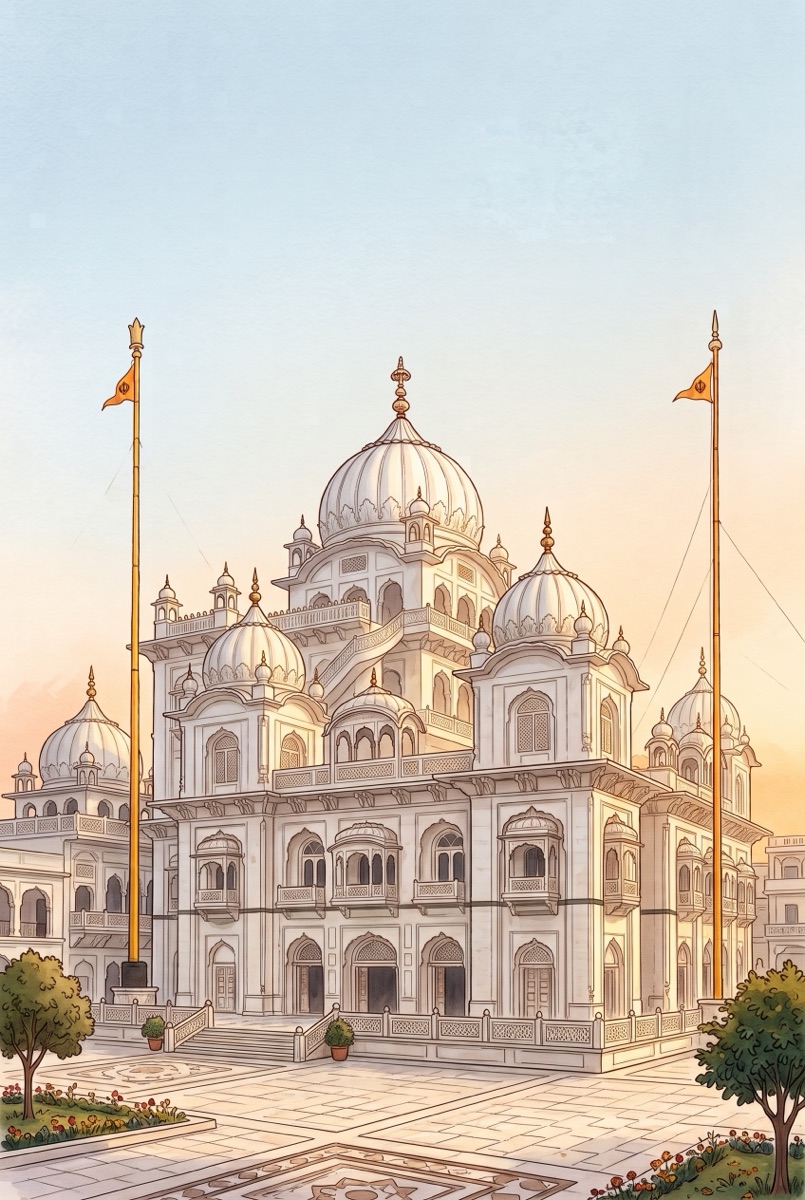
As a small boy in Patna, Guru Gobind Singh Ji taught His friends never to bow their heads to anyone in fear. He grew up to lead the Sikhs at only nine years old, filled Anandpur Sahib with kirtan, poets and learning, and on Vaisakhi created the Khalsa, then knelt and asked the Five Beloved Ones for Amrit Himself. He lost His father, His mother and all four of His sons, yet stayed in rising spirits and thanked the Creator. At Nanded He bowed before the Granth and made it the Guru forever. A Sikh story for ages 8–12.
The Boy by the Ganga
On the bank of the great river Ganga, in the city of Patna, a group of children were playing. In those days, whenever a nawab or a government official passed by, people bowed low before him, and the children did too. But one small boy stopped them, and told them to be fearless instead. Little by little, His friends grew so bold that they stopped bowing to the officials altogether.
That boy was Gobind Rai. One day, He would teach a whole people to walk with their heads held high.
He was born in Patna on 22 December 1666, to Mata Gujri Ji. His father, Guru Tegh Bahadur Sahib Ji, was far away in Dhaka, sharing Guru Nanak’s message with the sangats of the east. When the joyful news reached Him, He named His son Gobind Rai.
Gobind Rai spent the first years of His life in Patna, cared for by His mother’s brother. He picked up the local language from the neighbours’ children, while His mother and His grandmother, Mata Nanaki Ji, taught Him Punjabi at home.
When Gobind Rai was three or four, He would lead the other children down to the bank of the Ganga to play. His favourite game was a battle: He split His friends into two teams and they charged, dodged and defended until one side won. Even as a small child, He was brave and quick, and He became an expert with a bow and arrow.
The people of Patna loved this cheerful, fearless boy. He loved to sit in the sangat, to listen to kirtan and katha, and to talk about the Creator.
A rani who lived nearby, and had no children of her own, loved Him like a son. Once, when she wanted to cook something special for Him and His friends, He stopped her. “Just give us the puris and fried chickpeas you have already made,” He said.
When He was about three and a half, His father came back to Patna and saw Him for the very first time. Some time later, the family set out to join Guru Tegh Bahadur Sahib Ji, and the whole of Patna was sad to see Gobind Rai go.
Four Languages and a Question
After a long journey from Patna, Gobind Rai and His family reached Anandpur Sahib, the town His father had founded beside the river Sutlej. It would be His home for most of His life.
Anandpur was already becoming a place of learning, and Gobind Rai was eager to learn. A Muslim scholar, Qazi Mir Muhammad, taught Him Persian and Arabic. Pandit Kirpa Ram Ji, a scholar from Kashmir, taught Him Sanskrit. Munshi Sahib Chand Ji, the Granthi of the Guru’s house, taught Him to read and write Punjabi, and He studied the Bani of the Gurus who had come before.
His days had a steady rhythm. Before dawn and again in the evening, He sat in the darbar to listen to kirtan. In the afternoons, He trained with skilled riding masters His father had found for Him, and soon He could ride, shoot arrows, throw a spear and swim better than almost anyone.
Then, one day, a group of Pandits arrived from Kashmir. They were led by the same Pandit Kirpa Ram Ji who had taught Gobind Rai Sanskrit. They told Guru Tegh Bahadur Sahib Ji that the emperor’s governor was forcing them to give up their faith, and pleaded with Him to help them. Guru Ji listened, then told the sangat that only a great soul giving their life could stop such cruelty.
Gobind Rai was sitting in the darbar. He joined His hands and said:
“Who could be more worthy of that than you, Father?”
The sangat was stunned into silence. But His father’s heart filled with joy. Guru Tegh Bahadur Sahib Ji told the Pandits to send the emperor a message: if he could make Guru Tegh Bahadur Sahib Ji give up His faith, they would all follow. Then He prepared to go to Delhi Himself.
Guru Ji knew that He would not come back. In the Guru’s house, a Guru passed on the Light while still living, so the sangat would never be without a guide. He had seen His son’s love for Gurbani, His wisdom and, that day in the darbar, His fearless heart. He talked with His son about the hard times ahead, and asked Him always to trust the Creator alone and to draw strength from Gurbani and the lives of the Gurus who had come before.
Then, before the sangat, Guru Tegh Bahadur Sahib Ji passed the Light of Guru Nanak to His son and placed the whole sangat in His care. The tenth Guru, Guru Gobind Rai Ji, was just nine years old.
Soon after, in Delhi, Guru Tegh Bahadur Sahib Ji was martyred for the freedom of people whose faith was not His own. A brave young Sikh, Bhai Jaita Ji, carried His head all the way back to Anandpur, where His son received it with deep respect and cremated it with full honour.
(You can read the whole story of Guru Tegh Bahadur Sahib Ji in The Shelter of All*.)*
Heads Held High
A nine-year-old Guru, a father lost, and an emperor who had shown how far he would go: these were dangerous times for the Sikhs.
Guru Ji led the sangat so wisely that even the elders were amazed. He knew that the Sikhs would one day have to stand up to cruel rulers. So, from the very beginning, He began to prepare them.
He encouraged young Sikhs to practise riding, swimming, hunting and the use of weapons. He asked the sangat to bring fine weapons and horses as offerings, and they came, with their weapons and their courage. Anandpur filled with training grounds and contests. Workshops were built to make weapons, and forts began to rise around the town.
Guru Ji had a huge drum made, and named it the Ranjit Nagara, the drum of victory. Every morning and every evening, its deep boom rolled across the hills. Its sound filled the young Sikhs with courage, and made the hill rajas nervous.
Not everyone liked these changes. Some of the masands, the men who collected the sangat’s offerings, had grown lazy and greedy. They did not want any trouble with the emperor. They even went to Mata Gujri Ji, hoping she would persuade Guru Ji to keep the Sikhs busy only with prayer and to live quietly under Aurangzeb’s rule.
When Guru Ji heard this, He said that the emperor wanted people to walk with their heads bowed. “We want Sikhs to walk with their heads held high.” He would make His Sikhs able to stand like a wall against cruelty, to break the chains of slavery, and to shape their own future.
In the Guru’s langar, everyone sat together in one row, pangat, and ate the same food, rich and poor, high caste and low. This upset some people who believed that their caste made them better than others. A priest complained to Raja Bhim Chand, the ruler of the hill state where Anandpur stood, that Guru Ji was seating all castes together, training soldiers on his land, and holding court like a king. From then on, Bhim Chand looked at the Guru with jealous eyes.
Meanwhile, Anandpur grew into a home of kirtan and learning. When the emperor banned music in his courts, many musicians came to Anandpur, where kirtan was always honoured. Guru Ji Himself played the mridang, the jori and the sarinda beautifully. He invited poets and scholars from all over the land, Sikhs, Hindus and Muslims alike, and looked after all their needs. Sikhs remember that fifty-two poets lived at His court, writing poetry that filled people with courage.
Around this time, Guru Ji was married to Mata Sundari Ji, the daughter of Ram Sharan Ji of Lahore.
The Town by the Jamuna
The little kingdoms in the hills were always quarrelling with one another. Guru Ji often told the rajas to stop fighting each other for land.
The raja of Nahan heard about this. He was at war with his neighbour, the raja of Garhwal, and he asked Guru Ji to help them make peace. Guru Ji set out for Nahan with His poets and a band of Sikhs. When He arrived, He brought the two rajas together, and they made peace. The raja of Garhwal even gave back the land he had taken.
Near Nahan, on the bank of the river Jamuna, Guru Ji found a beautiful spot. First a few houses were built there, then a Gurdwara, then a fort. The place was named Paonta Sahib, after the place where Guru Ji set His foot.
At Paonta, the sangat gathered twice every day. In the peaceful air by the river, poets translated old books and wrote new poems, and Guru Ji held gatherings of poets, kavi darbars. Guru Ji spent much of His time in devotion to the Creator.
Wild animals lived in the forests around Paonta, and lions, leopards and wolves often carried off people and their cattle. Guru Ji and the Sikhs went out hunting them, and the villagers could breathe easily again.
Guru Ji wanted the Sikhs to be learned too. When a Brahmin scholar at Paonta refused to teach them Sanskrit, Guru Ji quietly sent five Sikhs to Banaras to study it, and they became the first Nirmalas, who spread learning among the Sikhs.
A well-respected Muslim saint, Pir Buddhu Shah of Sadhaura, often came to visit Guru Ji at Paonta. On his word, Guru Ji took five hundred Pathan soldiers into His service, men whom the emperor had dismissed from his army.
And at Paonta, Guru Ji’s first son was born to Mata Sundari Ji: Sahibzada Ajit Singh Ji.
The Pir and the Comb
Raja Bhim Chand had not forgotten his jealousy. He gathered the other hill rajas, and they sent Guru Ji a letter: obey us like a loyal subject, apologise for the past, or leave Anandpur. If not, we will take it by war.
Guru Ji wrote back that He lived on no one’s land, because His father had bought Anandpur and paid for it in full. “I am no one’s subject,” He wrote. If they wanted war, He was ready.
The rajas marched on Paonta with their armies. On the eve of the battle, most of the Pathan soldiers took their wages and went over to the rajas’ side, and the Udasi sadhus who had been living at Paonta slipped away in the night. Only one of them stayed: Mahant Kirpal Das.
When Pir Buddhu Shah heard that the Pathans he had vouched for had broken their word, he came to Guru Ji at once, with his four sons, two brothers and seven hundred followers.
The armies met at Bhangani, near the Jamuna. Ordinary people who had never trained as soldiers jumped into the fight: a cowherd named Lal Chand began firing arrows, and seeing him, a sweet-maker, also named Lal Chand, picked up a weapon too. Mahant Kirpal Das came onto the field with nothing but a heavy wooden staff. A Sikh carpenter, Bhai Rama Ji, arrived with two cannons he had made from wood.
Guru Ji rode on horseback among the Sikhs, and seeing their Guru beside them made them braver still. When the rajas’ best archer took aim at Guru Ji, one arrow struck His horse, one brushed past His ear, and one hit His belt, leaving only a small wound. Then Guru Ji drew His bow, and with a single arrow, the archer fell. The rajas’ armies fled. The Sikhs had won.
Many brave people gave their lives that day, among them two of Guru Ji’s cousins, and two sons and a brother of Pir Buddhu Shah.
The next morning, Guru Ji was combing His hair when Pir Buddhu Shah came to take leave. Guru Ji comforted him for the loss of his sons and brother, and praised their courage. To honour their bond forever, He gave the Pir a dagger, a fine robe and a hukamnama, a letter written in His own hand.
Then the Pir asked for one more thing: the comb Guru Ji had just used, with a few strands of His hair still caught in it.
Guru Ji gave it to him gladly.
After Bhangani, Guru Ji went back to Anandpur. On the way, at a great fair at Kapal Mochan, He told the crowds to leave behind superstitions about lucky and unlucky days and to follow the One Creator. The real demon, He told them, was slavery, and they should do everything they could to be free of it.
At Anandpur, He built a ring of forts to protect the town.
In the years at Anandpur, three more sons were born: Jujhar Singh Ji, Zorawar Singh Ji and Fateh Singh Ji.
In place of Holi, the festival of coloured powder, He started Holla Mohalla. The Singhs split into two teams, each led by a commander, and raced to capture a chosen spot. Guru Ji watched their skill and gave a siropa, a robe of honour, to the winning side. It was the game He had played as a boy on the bank of the Ganga, grown up. Holla Mohalla is still celebrated at Anandpur Sahib every year.
The Guru’s Golak
These were peaceful years at Anandpur, and Guru Ji often used them to teach in unexpected ways.
As Anandpur grew, many Sikhs ran their own langars, and each one praised his own. One night, Guru Ji dressed as a traveller and went from langar to langar, asking for food. At one, He was told, “Wait, be patient, the food is not ready.” At another, “The food is ready, but the Ardas has not been said yet.”
The next day, in front of the whole sangat, Guru Ji told everyone what had happened. Anyone in need, He said, must be served, whatever the hour. “Whoever turns someone in need away from their door turns me away.” And He added:
“The mouth of the poor is the Guru’s golak.”
A golak is the box where offerings for the Guru are placed. Feeding the hungry, Guru Ji meant, is the truest offering of all.
Another day, Guru Ji asked for a glass of water, and a Sikh who always sat in the front row jumped up and brought it. Guru Ji looked at his hands. They were very soft.
“Your hands are so soft,” Guru Ji said. “Have you never worked with them, never done seva?”
The Sikh explained that he came from a well-off family where servants did everything. This was the first time he had ever fetched water for anyone.
Guru Ji gently refused the glass. Hands that never serve others, He taught, are not pure. Sikhs strive to see the Creator in everyone and to serve everyone with their own hands.
By now, many masands had become dishonest, keeping the sangat’s offerings for themselves and speaking rudely to the people they were meant to serve. Guru Ji called them to account and ended the masand system for good. But one masand, Bhai Pheru Ji, came before Guru Ji on his own, with folded hands. When a record-keeper said Bhai Pheru’s offerings had not been arriving regularly, Guru Ji answered that this man had never kept a coin for himself. He had been giving clothes to people who had none and food to the hungry.
“What is given to the poor,” said Guru Ji, “reaches us directly.”
Around this time, the poet and scholar Bhai Nand Lal Ji came to live at Anandpur. His poems in praise of Guru Ji are so full of love that Sikhs still sing them in kirtan today.
Vaisakhi at Kesgarh
Years later, Guru Ji sent letters, hukamnamas, to Sikhs all over the land, asking them to come to Anandpur for Vaisakhi, and to come armed.
They came in their thousands, from every corner of the country. Early in the morning, the sangat gathered at Kesgarh, in Anandpur. Asa Di Vaar was sung, and the meaning of the Shabad was explained.
Then Guru Ji came onto the stage, and His voice rang out:
“I need a head.”
The whole sangat fell silent. Nobody had ever heard Guru Ji ask for such a thing.
Then one Sikh stood up: Bhai Daya Ram Ji, from Lahore. He came forward and bowed before Guru Ji, offering his head.
Guru Ji called out once more:
“I need a head.”
This time, Bhai Dharam Das Ji, from Delhi, stood up and offered his head. Three more times Guru Ji asked, and one by one, three more Sikhs rose: Bhai Himmat Ji from Jagannath Puri in the east, Bhai Mohkam Chand Ji, a cloth-printer from Dwarka in the west, and Bhai Sahib Chand Ji, a barber from Bidar in the south.
Five times Guru Ji had asked for a head, and five Sikhs had offered theirs.
Then Guru Ji had the five stand side by side before the sangat, dressed alike in turbans and robes of one colour, each with a kirpan at his side, radiant in their new form, and the sangat was filled with wonder. Now many in the sangat wished that they had been the first to stand up.
Guru Ji asked for an iron bowl, a bata. He filled it with clean water and added patase, sugar sweets. Then He knelt in the warrior’s posture and stirred the water with a double-edged sword, a khanda, while reciting Japji Sahib, Jaap Sahib, the Savaiye, Chaupai and Anand Sahib. This was Amrit.
He gave the Amrit to the five Sikhs, and added Singh, lion, to each of their names. They became the Panj Pyare, the Five Beloved Ones: Bhai Daya Singh Ji, Bhai Dharam Singh Ji, Bhai Himmat Singh Ji, Bhai Mohkam Singh Ji and Bhai Sahib Singh Ji.
Then something happened that no one expected.
Guru Ji, the Guru Himself, stood before the five Sikhs He had just given Amrit to, joined His hands, and asked them to give Amrit to Him.
The Panj Pyare prepared Amrit and gave it to their Guru. Gobind Rai became Guru Gobind Singh Ji.
The Guru who would not let children bow to officials, who told kings that He was no one’s subject, had bowed before His own Sikhs. The Guru and the Sikh had become one.
Guru Ji told the Panj Pyare that from that day on, their old caste and family background were gone. They now belonged to the Guru. Their birthplace was Kesgarh, and their home was Anandpur. They would keep the five Ks: Kes (uncut hair), Kangha (a wooden comb), Kara (a steel bracelet), Kachhera (cotton shorts) and Kirpan (a small sword). They would rise before dawn to remember the Creator and recite Gurbani, earn an honest living, join the sangat, and recite So Dar Rehras Sahib in the evening and Kirtan Sohila at night.
He told everyone to walk one path, to wipe out the differences of caste, to think no one higher or lower than another, and to drink Amrit from one bowl and love one another.
After that, thousands of people in the sangat took Amrit too. Women joined the Khalsa as well, and took the name Kaur, which means princess. Everyone who took Amrit became one family, the Khalsa, with Guru Gobind Singh Ji as their father.
Later, Guru Ji declared Mata Sahib Kaur Ji the mother of the whole Khalsa Panth. That is why, when Sikhs take Amrit, they are told that their spiritual father is Guru Gobind Singh Ji and their spiritual mother is Mata Sahib Kaur Ji.
The Long Siege
The hill rajas were furious. The Khalsa was made up of people they had looked down on: barbers, cloth-printers, farmers and water-carriers. And these people now stood tall, with weapons in their hands and their heads held high.
Again and again, the rajas attacked Anandpur, and again and again, the Singhs drove them back.
Some of the emperor’s own commanders came to love Guru Ji. Pir Buddhu Shah told one of them that Guru Ji was a true man of the Creator who had never taken an inch of anyone’s land: “If He is anyone’s enemy, He is the enemy of cruelty and injustice.” One Mughal commander left his army in the middle of a battle and came to live at Anandpur, and later gave his life defending the Guru.
At last, the emperor ordered the governors of Delhi, Lahore, Sirhind, Jammu and Multan to join the hill rajas, surround Anandpur, and capture Guru Ji. A vast army arrived. Guru Ji placed bands of five hundred Singhs in each fort, and for weeks the Singhs held them off.
So the armies surrounded the town and cut off all food and water, hoping to starve the Sikhs out. Month after month passed. The food ran so low that each Singh had a handful of chickpeas a day, and sometimes not even that. At the end, they ground up tree bark to eat. Even the horses and elephants grew weak with hunger.
Then the enemy leaders sent a letter with promises sworn on the Quran and on the Gita: leave Anandpur, and no one will harm you. Many people in the town, worn out by the long siege, urged Guru Ji to accept.
Guru Ji told them it was a trick, and He showed them. At midnight, He sent out carts, mules and donkeys loaded with old rags, broken shoes and rubbish, all covered in rich cloth, with torches tied on top. The enemy soldiers broke their promise at once and fell upon the carts, hoping for treasure. All they found was rubbish.
Still, after six or seven months, there was nothing left to eat. Guru Ji and His Singhs decided to leave. On a cold winter night, they set out from Anandpur in two groups: Mata Gujri Ji, Mata Sundari Ji and Mata Sahib Kaur Ji went ahead with a band of Singhs, carrying precious literature, and Guru Ji followed with His two elder sons and the rest of the Singhs.
As soon as the Sikhs were out in the open, the armies attacked. By the time the Sikhs reached the river Sarsa, it was in flood, roaring and icy cold, with the enemy close behind.
Guru Ji’s family was split into three. Mata Sundari Ji and Mata Sahib Kaur Ji crossed with Bhai Mani Singh Ji and later reached Delhi. Mata Gujri Ji and the two younger Sahibzade, Zorawar Singh Ji and Fateh Singh Ji, were swept apart from everyone else, and went with the family cook, Gangu, to his village. Guru Ji, with His two elder sons, Ajit Singh Ji and Jujhar Singh Ji, crossed with a small jatha of Sikh riders. Many Singhs were lost in the freezing water, and so was a great treasure of precious literature.
All of You Are My Sahibzade
By evening, Guru Ji reached Chamkaur with His two elder sons and only forty Singhs. The people of Chamkaur welcomed them, and the owner of a mud-walled house, a haveli, invited them to shelter there. Sikh history remembers it as the kachi garhi, the mud fort.
The next morning, the emperor’s soldiers surrounded it on every side. Forty hungry, exhausted Singhs faced an army too large to count.
The governor of Sirhind sent a crier around the walls: if Guru Ji surrendered, His life would be spared. Guru Ji’s only answer was a shower of arrows.
The Singhs went out in bands of five to meet the enemy, while Guru Ji and the others fought from the walls. When the enemy prepared one huge attack, the Singhs pleaded with Guru Ji to escape with His sons.
Guru Ji looked at them. “Which Sahibzade are you talking about?” He said. “All of you are my Sahibzade.”
Then Guru Ji gave Sahibzada Ajit Singh Ji, who was about eighteen, permission to go out and fight. He hugged him and told him that He would be glad to watch him. Ajit Singh Ji fought with great courage, and gave his life. Guru Ji called out a loud jaikara.
His younger brother, Sahibzada Jujhar Singh Ji, only fourteen, asked to go next, and Guru Ji sent him gladly. As the sun went down, Jujhar Singh Ji too gave his life. Again, Guru Ji called out a jaikara.
Night fell. After Rehras Sahib, Guru Ji told the remaining Singhs that at dawn, He Himself would lead the next band out.
The Singhs were determined that their Guru would live, to lead the Panth and raise more Sikhs. So, encouraged by Bhai Daya Singh Ji, they chose five of themselves as Panj Pyare, and these five gave their Guru the Panth’s order: leave the fort tonight and go somewhere safe.
On Vaisakhi, Guru Ji had asked the Five for Amrit. Now the Five gave their Guru an order, and He bowed to it.
Guru Ji gave His plumed kalgi and His clothes to Bhai Sangat Singh Ji, so the enemy would think Guru Ji was still in the fort. After midnight, Guru Ji went out with three Singhs, Bhai Daya Singh Ji, Bhai Dharam Singh Ji and Bhai Man Singh Ji, and climbed a high mound in the dark.
Guru Ji did not leave in silence. From the mound, He called out a challenge to the whole army:
“The Pir of Hind is leaving! Whoever has the courage, come and catch Him!”
The three Singhs took up the call from different places. The enemy soldiers woke up in alarm and began fighting each other in the dark. When a torch-bearer lit a torch, Guru Ji’s arrow knocked it from his hand. In the confusion, Guru Ji and the three Singhs passed right through the army. Then they went separate ways in the dark, each following the stars they had agreed on, so they could find each other again.
In the morning, the last Singhs in the fort, Bhai Sangat Singh Ji among them, came out and gave their lives.
A Clay Pot for a Pillow
Guru Ji walked through the dark, alone. The way was full of thorny bushes, and soldiers were searching every village for Guru Ji. He walked through fields and forests, His feet torn by thorns and covered in blisters. He ate wild berries from the bushes when He was hungry.
At Machhiwara, He lay down to rest in a garden, His clothes in tatters, with an empty clay pot for a pillow.
That is where the three Singhs, following their stars, found Guru Ji. When they saw their Guru, the wearer of the plume, sleeping on the bare ground with blistered feet, their hearts overflowed. They woke their Guru with Fateh.
Machhiwara was not safe. Two Muslim brothers, Ghani Khan and Nabi Khan, who used to sell horses to Guru Ji, came to help. In those days, the Pirs of a place called Uch, Muslim spiritual guides, wore blue robes and kept their hair long under a turban, and their followers carried them from village to village on a bed. So Guru Ji and the Singhs dressed in blue, and Ghani Khan, Nabi Khan and two of the Singhs lifted Guru Ji on a bed and carried Him away, telling everyone they met that this was the Pir of Uch.
At one village, soldiers stopped them, suspicious. Guru Ji spoke to them in Persian. A Qazi from a nearby village was called to look at Guru Ji. It was Qazi Mir Muhammad, who had taught Guru Ji Persian when He was a boy. He recognised his old pupil at once. And he told the soldiers that yes, this was truly the Pir of Uch.
Later, Guru Ji thanked Ghani Khan and Nabi Khan and gave them a letter telling the Khalsa always to honour them, because they had risked their lives for Him.
Then terrible news reached Guru Ji from Sirhind.
The family cook, Gangu, had betrayed Mata Gujri Ji and the two younger Sahibzade to the governor of Sirhind, Wazir Khan, for a reward. The little Sahibzade were brought into the governor’s court. The main door was shut, so that they would have to bow their heads to come through the small doorway beside it. But they stepped through feet first, so their heads were never bowed. Inside, they called out “Waheguru Ji Ka Khalsa, Waheguru Ji Ki Fateh!” in loud, clear voices.
They would not give up their faith, whatever they were offered or threatened with. The Nawab of Malerkotla protested that it was wrong to punish children. But Wazir Khan ordered their deaths, and the two Sahibzade gave their lives in Sirhind. Mata Gujri Ji became a martyr too.
Everyone around Guru Ji wept. Guru Ji sat calm and still. When the news had been told, Guru Ji thanked Akal Purakh, the Creator, for giving the Sahibzade such strength that they stayed steady to the end.
At Dina, Guru Ji wrote a letter in Persian to the emperor Aurangzeb, and named it the Zafarnama, the letter of victory. In it, He reminded the emperor of the oaths he had broken. When every other way has failed, He wrote, it is right to take up the sword. What does it matter that my four children have been killed? The coiled cobra, the Khalsa, is still here. And He wrote: if the Creator is your friend, what can an enemy do?
Bhai Daya Singh Ji carried the Zafarnama all the way to the emperor in the south. It shook Aurangzeb. He gave orders that no one should fight Guru Ji or stop Him from going wherever He wished.
The Pool of Freedom
Some of the Singhs who had been separated from Guru Ji at the Sarsa had gone home. When they heard what had happened at Chamkaur and Sirhind, and that Guru Ji was in Malwa, their hearts ached with shame for having left their Guru in His hardest days.
A brave woman from Jhabal, Mai Bhago Ji, stirred them to go back. She rode with them herself.
They found Guru Ji just as the governor of Sirhind’s army was coming after Him again. Guru Ji had chosen a place called Khidrana, beside a pool of water in a dry land where there was no other water for miles. The Singhs who had come back took their positions in front, and spread sheets over the bushes so that the enemy would think a big Sikh army was camped in tents there.
The battle was fierce. From a little hill, Guru Ji showered arrows on the enemy and sent Singhs where they were needed. The Singhs held the only water, and in the summer heat, the enemy soldiers grew desperate with thirst. In the end, they turned and marched away.
When it was over, Guru Ji walked among the wounded. Mai Bhago Ji was wounded too. She had fought the enemy with a staff in her hands.
Among the wounded lay Bhai Mahan Singh Ji, near the end of his life. When he saw his Guru, he remembered how he had left Him at the Sarsa, and in a weak voice, he asked forgiveness for himself and his companions. Guru Ji forgave them. There were tears of joy in Bhai Mahan Singh Ji’s eyes as he breathed his last.
The place was named Muktsar, the pool of freedom. Every year, at the festival of Maghi, a great gathering of sangat remembers those who gave their lives there.
Damdama Sahib
After Muktsar, Guru Ji travelled from village to village, and many people took Amrit.
At Talwandi Sabo, a local chief, Chaudhri Dalla, welcomed Guru Ji. Here, after years of war and hardship, Guru Ji at last loosened His waistband and rested, and so the place came to be called Damdama Sahib, the place of breath and rest. He stayed there for many months.
Chaudhri Dalla liked to boast about his brave soldiers. If his men had been with Guru Ji, he said, the Sahibzade would never have been killed. Guru Ji told him that courage is not only in big muscles. It comes from a steady mind and a heart ready to give itself.
One day, a Sikh from Lahore brought Guru Ji a new musket. In front of Dalla and his men, Guru Ji said He wanted to test how true it shot, and asked Dalla to send one of his soldiers to stand as the target. Dalla’s men looked at one another, and one by one, they slipped away. Not one would come.
Outside stood a father and son, Bhai Bir Singh Ji and Bhai Dhir Singh Ji. Guru Ji sent for one of them. Both came running, each trying to get in front of the other. “I heard the order first!” each one said. Guru Ji stood them one behind the other, and the one at the back stood on tiptoe, so that he would be the target. Guru Ji took aim at them both. Neither moved. Then Guru Ji raised the musket and fired into the air, high over their heads.
Dalla understood at last. His men fought for wages. The Guru’s Sikhs gave their hearts.
Dalla had stood up bravely for Guru Ji, even when the governor of Sirhind threatened him. One day, Guru Ji told him that there was no shortage of anything in Guru Nanak’s house, and asked what he wanted. Dalla answered that he had wealth, land and honour already. “Give me a place at your feet,” he said, “just the size of a little stool.”
Guru Ji explained that love for the Guru cannot be bought with money or land. “Take the same pledge the Singhs have taken, that I have taken,” He said. Dalla took Amrit, became Bhai Dalla Singh, and brought his whole family to take Amrit too.
At Damdama Sahib, Mata Sundari Ji and Mata Sahib Kaur Ji came from Delhi with Bhai Mani Singh Ji. When they heard about the four Sahibzade, their eyes filled with tears. Guru Ji comforted them, and asked them to accept the Creator’s will as sweet.
And here, under Guru Ji’s own guidance, Bhai Mani Singh Ji compiled the Adi Granth once more, including the Bani of Guru Tegh Bahadur Sahib Ji in its proper raags. Poets gathered again, and Damdama Sahib filled with sangat from all around.
The Road South
Guru Ji decided to go south and meet the emperor Himself. On the way, at a place called Naraina, He saluted the tomb of a saint with the tip of an arrow.
The Singhs were shocked. “You tell us never to worship at tombs,” they said, “and now you have saluted one! You have broken the rule. We will fine you.”
Guru Ji was delighted to see how wide awake His Singhs were. He told them He had only been testing them. “Still, I deserve a fine,” He said, “and I accept whatever you decide.”
On the journey, news came that Aurangzeb had died. His sons began fighting over the throne. The eldest, Bahadur Shah, asked Guru Ji for help, promising to punish those who had done such cruelty to Guru Ji’s family and the people. Guru Ji sent a band of Singhs, and Bahadur Shah won.
In Delhi, Guru Ji stayed for a while in a neighbourhood of shoemakers called Mochi Bagh, the cobblers’ garden. He renamed it Moti Bagh, the garden of pearls.
When Bahadur Shah invited Guru Ji, Guru Ji rode to the emperor’s fort at Agra, with His sword at His side and His plume on His turban. The emperor came to the gate to receive Guru Ji, and offered Him a robe of honour and a jewelled plume. By custom, a robe of honour had to be put on in front of the emperor. Guru Ji did not put it on. He had it carried back to His camp. Some courtiers were offended, but Bahadur Shah said that Guru Ji was a leader in matters of both faith and the world, and should be honoured like a king.
Guru Ji travelled south with Bahadur Shah for a while. But the emperor kept putting off his promises, and at last, Guru Ji parted from him and went on to Nanded, on the bank of the river Godavari.
The Eternal Guru
At Nanded lived a hermit named Madho Das. He had left home as a teenager and followed many different spiritual guides, but his restless heart had never found peace. Guru Ji went to his camp.
Madho Das asked who had come to his camp. Guru Ji answered, “The one you know.” When Madho Das asked if this was Guru Gobind Singh Ji, Guru Ji said yes. Madho Das asked why He had come, and Guru Ji said, “To make you my Singh.” Madho Das accepted at once. “I accept, Maharaj,” he said. “I am your banda*, your servant.”*
Guru Ji gave him Amrit, and named him Banda Singh. Hearing Gurbani and the history of the Sikhs, Banda Singh was completely changed. Guru Ji gave him the title Bahadur, the brave, and sent him north with five arrows, a drum, a Nishan Sahib and letters to the sangats, to stand up for the people against cruelty.
The governor of Sirhind, Wazir Khan, still feared what Guru Ji’s friendship with the emperor might mean for him. He had sent two men after Guru Ji. One evening, after Rehras Sahib, one of them attacked Guru Ji in His tent with a dagger and wounded Him deeply. Guru Ji struck him down with His sword, and the Singhs caught the other. A surgeon stitched the wound, and it began to heal.
But some days later, as Guru Ji drew back the string of a strong bow, the stitches tore open. Guru Ji told the Sikhs that His time had come.
That same day, Guru Ji called the sangat together. In front of everyone, He declared that the line of Gurus in human form was complete. From now on, the Guru would be Sri Guru Granth Sahib Ji, the Shabad, together with the Khalsa Panth walking by its teaching. Five dedicated Singhs, living by the teaching of Sri Guru Granth Sahib Ji, would speak for the whole Panth.
Then Guru Gobind Singh Ji bowed before Sri Guru Granth Sahib Ji.
The boy who had told the children of Patna never to bow to an official had bowed only to His own Sikhs. Now He bowed to the Shabad. Ever since, Sikhs have remembered: anyone who wants to see the Guru should look into Sri Guru Granth Sahib Ji, and anyone who wants to speak with the Guru should read it.
On 7 October 1708, in the peaceful early hours before dawn, Guru Gobind Singh Ji merged with the eternal Light at Nanded. Today, Takht Sri Hazur Sahib stands at that place.
Reflection
Guru Gobind Singh Ji was a poet and a warrior, a musician and a scholar, a leader of armies and a father to the whole Khalsa.
As a little boy, He taught His friends never to bow their heads in fear. As a Guru of nine, He began to make the Sikhs strong. He filled Anandpur with kirtan, poetry and learning, and taught that the mouth of a hungry person is the Guru’s golak.
On Vaisakhi, He gave people of every caste one bowl of Amrit and one family, then knelt and asked His own Sikhs for Amrit. He lost His father, His mother and all four of His sons, yet stayed in Chardi Kala and thanked the Creator. And at the end of His life, He bowed before Sri Guru Granth Sahib Ji and made the Shabad the Guru forever.
Whenever you stand up straight for what is right, or share food with someone who is hungry, or sit before Sri Guru Granth Sahib Ji, remember the tenth Guru, who taught His Sikhs to walk with their heads held high.
Quick Facts
| Fact | Detail |
|---|---|
| Born | 22 December 1666 |
| Birthplace | Patna |
| Parents | Guru Tegh Bahadur Sahib Ji and Mata Gujri Ji |
| Original name | Gobind Rai |
| Wife | Mata Sundari Ji |
| Mother of the Khalsa | Mata Sahib Kaur Ji |
| Children | Four sons: Sahibzada Ajit Singh Ji, Sahibzada Jujhar Singh Ji, Sahibzada Zorawar Singh Ji and Sahibzada Fateh Singh Ji |
| Light received from | Guru Tegh Bahadur Sahib Ji, His father |
| Town of His Guruship | Anandpur Sahib |
| Known for | Creating the Khalsa; teaching Sikhs to walk with heads held high; making Anandpur Sahib a home of kirtan and learning; passing the Guruship to Sri Guru Granth Sahib Ji |
| Successor | Sri Guru Granth Sahib Ji, the eternal Guru |
| Passed away | 7 October 1708, at Nanded |
Discussion Questions
Let’s Talk About It: At Chamkaur, the Singhs pleaded with Guru Ji to escape with His sons, and He answered, “All of you are my Sahibzade.” What do you think He meant?
Let’s Think About It: Guru Ji never bowed to an emperor, yet He asked the Panj Pyare for Amrit, obeyed their order at Chamkaur, and accepted a fine from His own Singhs. What does that tell us about Guru Ji and the Khalsa?
Let’s Think About It: Bhai Bir Singh Ji and Bhai Dhir Singh Ji raced to be first, while Chaudhri Dalla’s soldiers slipped away. What is the difference between doing something for wages and doing it with love?
Let’s Try It: Guru Ji refused the glass of water from a Sikh whose hands had never served anyone. This week, choose one job at home or at the Gurdwara and do it with your own hands, without being asked.
Let’s Try It: The Panj Pyare came from Lahore, Delhi, Jagannath Puri, Dwarka and Bidar. Find these places on a map and draw a line from each one to Anandpur.
Word Meanings
| Word | Meaning |
|---|---|
| Akal Purakh | The Timeless Creator. |
| Amrit | The sweetened water, stirred with a khanda while Gurbani is recited, given when a Sikh joins the Khalsa. |
| Ardas | The prayer Sikhs say standing together, asking for the Creator’s help and blessing. |
| Bani | The hymns of the Gurus and the Bhagats. |
| Bata | An iron bowl, used to prepare Amrit. |
| Chardi Kala | Rising spirits: staying hopeful and strong, whatever happens. |
| Darbar | The Guru’s court, where the sangat gathers. |
| Fateh | Victory: the Sikh greeting, Waheguru Ji Ka Khalsa, Waheguru Ji Ki Fateh. |
| Golak | The box where offerings for the Guru are placed. |
| Granthi | The person who looks after Sri Guru Granth Sahib Ji and reads from it. |
| Haveli | A large house built around a courtyard. |
| Hind | An old name for the land of India. |
| Hukamnama | A letter of instruction from the Guru. |
| Jaikara | A joyful shout of Bole So Nihal, Sat Sri Akal. |
| Jatha | A band of Sikhs who travel or serve together. |
| Kalgi | A plume worn on the turban. |
| Katha | An explanation of Gurbani or Sikh history. |
| Kavi darbar | A gathering of poets. |
| Kesgarh | The place in Anandpur Sahib where the Khalsa was created. Takht Sri Kesgarh Sahib stands there today. |
| Khalsa | The family of Sikhs who have taken Amrit; the word means pure, belonging to the Creator alone. |
| Khanda | A double-edged sword. |
| Kirtan | Singing Gurbani together, usually with music. |
| Langar | The free community kitchen, where everyone sits together in equal rows to eat. |
| Mahant | The head of a group of sadhus. |
| Masand | A person who once collected offerings for the Guru from the sangats. |
| Mridang, jori and sarinda | Two kinds of drum (mridang and jori) and a bowed string instrument (sarinda), played in kirtan. |
| Nawab | A Mughal governor or nobleman. |
| Nirmalas | Sikh scholars, beginning with the five Sikhs Guru Ji sent to study Sanskrit in Banaras. |
| Nishan Sahib | The Sikh flag. |
| Pangat | Sitting together in one row to eat, with no one higher or lower. |
| Panj Pyare | The Five Beloved Ones, the first five Sikhs to take Amrit, and any five Singhs chosen to represent the Panth. |
| Panth | The whole Sikh community, walking the Guru’s path together. |
| Patase | Small sugar sweets, added to the water when Amrit is prepared. |
| Pir | A title for a Muslim spiritual guide. |
| Qazi | A Muslim judge and scholar. |
| Rehras Sahib | The Gurbani Sikhs recite in the evening; it begins with the Shabad So Dar. |
| Sahibzade | The sons of the Guru. |
| Sangat | The community of Sikhs who gather together for kirtan, to learn, and to serve. |
| Seva | Selfless service, given without wanting anything in return. |
| Shabad | A hymn of Gurbani; also the Divine Word, which is the eternal Guru. |
| Siropa | A robe or scarf of honour. |
| Takht | Throne: one of the five seats of Sikh authority. |
| Udasi | A member of the Udasi order of sadhus. |
| Zafarnama | The letter of victory: Guru Gobind Singh Ji’s letter in Persian to the emperor Aurangzeb. |
Explore More
- The Shelter of All: The Life of Guru Tegh Bahadur Sahib Ji — on the Ninth Guru, Guru Gobind Singh Ji’s father, who gave His life for freedom of faith
- Char Sahibzade — the four sons of Guru Gobind Singh Ji, and how Sikhs remember them
- The Panj Pyare — the lives of the Five Beloved Ones who stood up on Vaisakhi