Featured
Simran Kaur and the Lost Sketchbook
Available on Amazon
Bring this inspiring story into your home. Every copy sold helps us create more resources for Sikh children.
On a class trip to High Park, Simran finds a lost sketchbook full of beautiful drawings — and follows the clues inside to return it to its owner.
Fourteen Red Doors
Simran Kaur counted everything.
She counted the steps from her front door to the sidewalk (seven). She counted the red doors on her street (fourteen). She counted the cracks in the pavement that she had to jump over on the way to school (twenty-three, but she always lost count around the big maple tree).
This morning, the air was cold and bright. Simran walked fast, her backpack bouncing. Her lunchbox swung from one hand, and every few steps it bumped against her wrist with a small, familiar sound.
Clink.
That was her kara — the steel bracelet she always wore. It had been on her wrist for as long as she could remember, the same way her shoes were on her feet and her hair was in its braid. It was just part of her.
Today was not a regular day. Today was the class trip to High Park.
Simran had been counting down the days (eleven). She had packed her bag the night before. She had told her dad at least four times that she needed to be at school early.
"You'll be fine," he said, kissing the top of her head. "You notice things other people miss, Simran. That's your superpower."
She wasn't sure about that. But she liked the way it sounded.
The Sketchbook
High Park was enormous. The trees were still half-bare from winter, but the first green buds were starting to show, tiny and bright, like the park was holding its breath before spring.
Ms. Adeyemi led the class along the main path. "Stay with your buddy," she said. "And no running near the pond."
Simran's buddy was Ethan, who was already running near the pond.
She let him go ahead. She was busy counting the ducks (nine... ten... eleven — wait, was that one a goose?).
That's when she saw it.
A small sketchbook, lying open on a wooden bench near the water. Its pages fluttered in the breeze like it was waving at her.
Simran sat down and picked it up. The cover was soft and blue, a little worn at the corners. She opened the first page.
A drawing. A perfect, careful drawing of a willow tree — its long branches reaching down to touch the water. Whoever had drawn this was good. Really good.
She turned the page. A red cardinal sitting on a fence. Then a fat orange cat curled in a window. Then the Grenadier Pond with all eleven ducks (so it was eleven — Simran felt a small flash of triumph).
On the inside front cover, someone had written in pencil:
This book belongs to Maya. Please return if found.
There was no last name. No phone number. Just Maya.
Simran looked around. The bench was empty. The path was empty. Whoever Maya was, she was gone.
She could leave the sketchbook on the bench. Someone else might find it. Or she could give it to Ms. Adeyemi.
But Simran looked at the drawings again. The willow tree had every branch in exactly the right place. The cardinal's feathers were drawn one by one. Whoever Maya was, she had spent a long time on these. Losing this book would hurt.
Simran closed the sketchbook and stood up. The latch on the bench was cold and her kara clinked against it, sharp and clear.
She was going to find Maya.
The Trail
The next drawing in the sketchbook was the old stone bridge — the one that crossed the creek deeper in the park. Simran knew it. She had counted its stones once (forty-seven, give or take).
She tucked the sketchbook under her arm and walked.
The bridge was quiet. Water ran underneath, cold and quick. Simran leaned on the railing and looked at the drawing again, then at the real bridge. Maya had drawn it from this exact spot. She had even included the crack in the third stone.
"You looking for something?"
Simran looked up. An older man in a green jacket was standing at the other end of the bridge with a walking stick and a thermos. He had kind eyes and a Blue Jays cap.
"I found a sketchbook," said Simran. "It belongs to someone called Maya. Have you seen anyone drawing?"
The man thought for a moment. He took a slow sip from his thermos.
"There was a girl," he said. "Maybe ten, eleven? She was sitting right here about an hour ago, drawing the creek. She went that way." He pointed toward the adventure playground with his walking stick.
"Thank you," said Simran.
She walked on. Her kara caught a sliver of sunlight as she swung her arms, and it flashed once, bright, then gone.
The adventure playground was loud and full of kids from different schools. Simran scanned the benches, the swings, the climbing frame. No one was drawing.
But then she heard something — a small, hiccupping sound, half-hidden behind the noise.
A little boy, maybe four or five, was standing at the bottom of the climbing frame. He was crying — the quiet kind of crying where your face scrunches up but no sound comes out. His shoelace was caught in the wooden slats and he couldn't pull it free.
Simran put the sketchbook in her backpack and crouched down.
"Hold still," she said. "I've got it."
The lace was tangled tight. She worked it loose with both hands, her fingers steady and patient. The boy sniffed and watched her. When the lace came free, he looked up at her like she had performed a miracle.
"Thank you," he whispered.
A woman rushed over — his mum — and scooped him up, thanking Simran three times. Simran barely heard her. She was already looking at the next drawing in the sketchbook.
A big oak tree with a hollow in its trunk. She knew that tree. It was near the allotment gardens, on the hill.
The Girl by the Oak
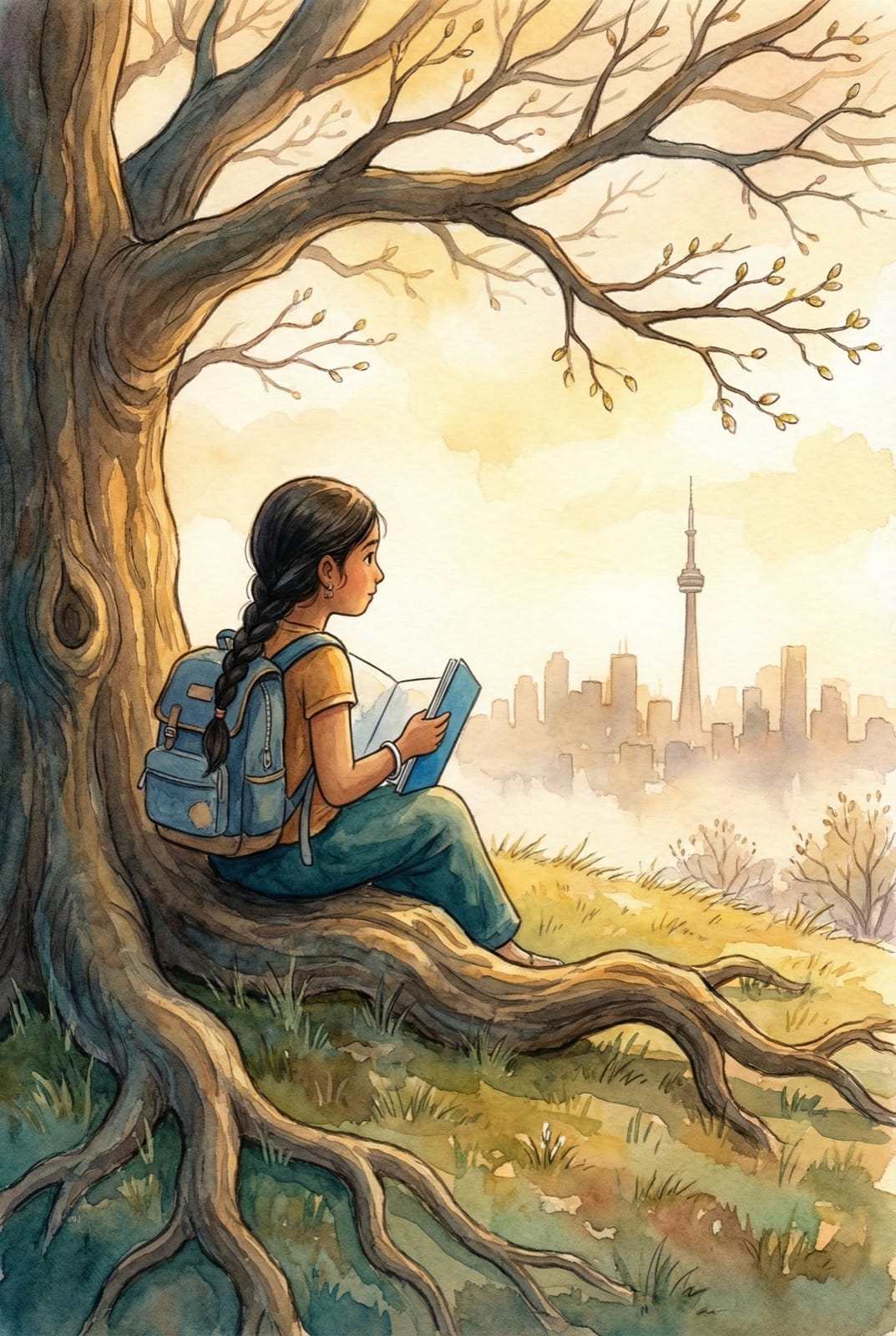
Simran climbed the hill. The wind picked up as she got higher, and the whole city opened up below her — the CN Tower in the distance, the lake shimmering grey and silver, the tops of trees stretching out like a green blanket being shaken smooth.
She found the oak tree. It was massive and old and dignified, the kind of tree that looked like it had opinions.
And there, sitting on the roots with her knees pulled up to her chest, was a girl.
She was maybe a year older than Simran. She had dark hair in two long plaits and paint smudges on her fingers. She was not drawing. She was staring at the ground with the look of someone who had lost something important and had given up looking.
Simran sat down next to her. Not too close. Just close enough.
"Are you Maya?"
The girl looked up, startled.
"How do you know my name?"
Simran unzipped her backpack and pulled out the blue sketchbook. She held it out with both hands, the way you hold something that matters.
Maya stared at it. Then she grabbed it and pressed it against her chest like a lost friend. Her eyes filled up, but she didn't cry. She just held it.
"Where did you find it?" she whispered.
"On the bench by the pond. I followed your drawings."
Maya opened the book and flipped through the pages — the willow, the cardinal, the bridge, the oak — checking that they were all there. Her shoulders dropped with relief.
"I thought it was gone forever," she said. "My nani gave me this sketchbook. She's a painter in Mumbai. She told me to fill every page."
"How many pages left?" asked Simran. She couldn't help it.
Maya almost smiled. "Fourteen."
"I count things too," said Simran.
They sat there for a moment, on the roots of the big oak tree, the wind moving the branches above them. Maya opened to a blank page. She looked at Simran.
"Can I draw you?"
Simran didn't know what to say. Nobody had ever asked to draw her before. She nodded and sat still — which was hard, because Simran was not very good at sitting still.
Maya's pencil moved quickly. Simran watched from the corner of her eye. She saw Maya draw her braid, her backpack straps, her hands resting on her knees. And on her wrist — a small circle, simple and precise.
Her kara. Maya had drawn it like it was the most natural thing in the world.
When Maya was done, she turned the sketchbook around. There was Simran — sitting on the roots of the oak tree, the city behind her, the wind in her braid, and a quiet, curious look on her face.
"That's me?" said Simran.
"That's you," said Maya.
Counting New Things
Ms. Adeyemi was not thrilled that Simran had wandered off from her buddy group. Ethan had apparently not noticed she was gone, which was both annoying and unsurprising.
But when Simran explained about the sketchbook, Ms. Adeyemi's face softened.
"That was a kind thing to do, Simran," she said.
On the bus ride back to school, Simran pressed her forehead against the window and watched the city go by. She counted the streetlights (she lost count at thirty-nine). She counted the dogs she could see from the bus (seven). She counted the number of times she had used her hands today — to untangle a boy's shoelace, to carry a sketchbook across a park, to hold something out to a stranger who needed it back.
She stopped counting. Some things, she realised, were not about numbers.
Her kara was warm against her wrist. It had been there all day — at the pond, on the bridge, at the playground, under the oak tree. She hadn't thought about it once. But it had been there.
Clink.
The bus went over a bump. Simran smiled.
Fourteen red doors. Eleven ducks. One sketchbook. One girl named Maya.
And tomorrow, Simran would count new things.
Discussion Questions
Let's Talk About It: Simran could have left the sketchbook on the bench or given it to her teacher. Instead, she decided to find Maya herself. Why do you think she made that choice?
Let's Think About It: Simran's dad says she notices things other people miss. How does that help her during the adventure? What kinds of things do you notice that other people might not?
Let's Talk About It: Maya's nani gave her the sketchbook and told her to fill every page. Do you have something special that someone in your family gave you? What makes it important?
Let's Try It: On your next walk — to school, to the park, to the shops — try counting something you've never counted before. How many blue cars? How many birds? How many people smiling? See what you notice.
Let's Think About It: At the end of the story, Simran says "some things are not about numbers." What do you think she means?
Word Meanings
| Word | Meaning |
|---|---|
| Kara | A steel bracelet, worn on the wrist — one of the five articles of Sikh identity |
| Nani | Grandmother (maternal) — a term of love |
About This Story
This story is the first in the Simran Kaur series — five stories set in Toronto, each woven around one of the Five Kakars (the five articles of Sikh identity given by Guru Gobind Singh Ji to the Khalsa in 1699). In this story, the Kara — a steel bracelet worn on the wrist — is present throughout as part of Simran's everyday life. The story does not explain the Kara's significance. It simply shows a girl whose hands are always in motion — counting, helping, carrying, returning — and the Kara is always there.
High Park is a real park in Toronto's west end, beloved by families. The Grenadier Pond, the stone bridge, the oak trees, and the adventure playground are all real.
Explore More
- The Five Kakars — Articles of Sikh Faith — What the Five Kakars are and why they matter
- The Drumbeat: A Holla Mohalla Story — Another story of a girl discovering something beautiful
- Hair Twins — A picture book celebrating Sikh identity through hair
Available on Amazon
Bring this inspiring story into your home. Every copy sold helps us create more resources for Sikh children.
Free Coloring Sheet
A printable coloring page inspired by this story — great for after reading together.
Download PDF View all coloring sheets