Featured
Simran Kaur and the Knot
Available on Amazon
Bring this inspiring story into your home. Every copy sold helps us create more resources for Sikh children.
When Simran comes home from school with a knot in her hair and a knot in her chest, her mum's steady hands and a small wooden comb help her untangle both.
Zero
Simran Kaur did not count the steps from the school bus to her front door.
She did not count the cracks in the pavement or the red doors on her street. She did not count anything.
She dropped her backpack by the stairs, kicked off her shoes, and went straight to the kitchen.
Her mum was chopping onions. She looked up.
"How was —"
"Fine," said Simran.
It was not fine.
She sat at the table and ate her roti and daal without talking. She drank her glass of milk without counting the sips. She stared at the fridge magnets — twelve of them, she knew, because she had counted them a hundred times — but tonight they were just shapes.
Her dad came in from the garden and ruffled her hair. "Everything okay, puttar?"
"Yes."
He looked at her mum. Her mum gave a small shake of her head. Later.
The Comb
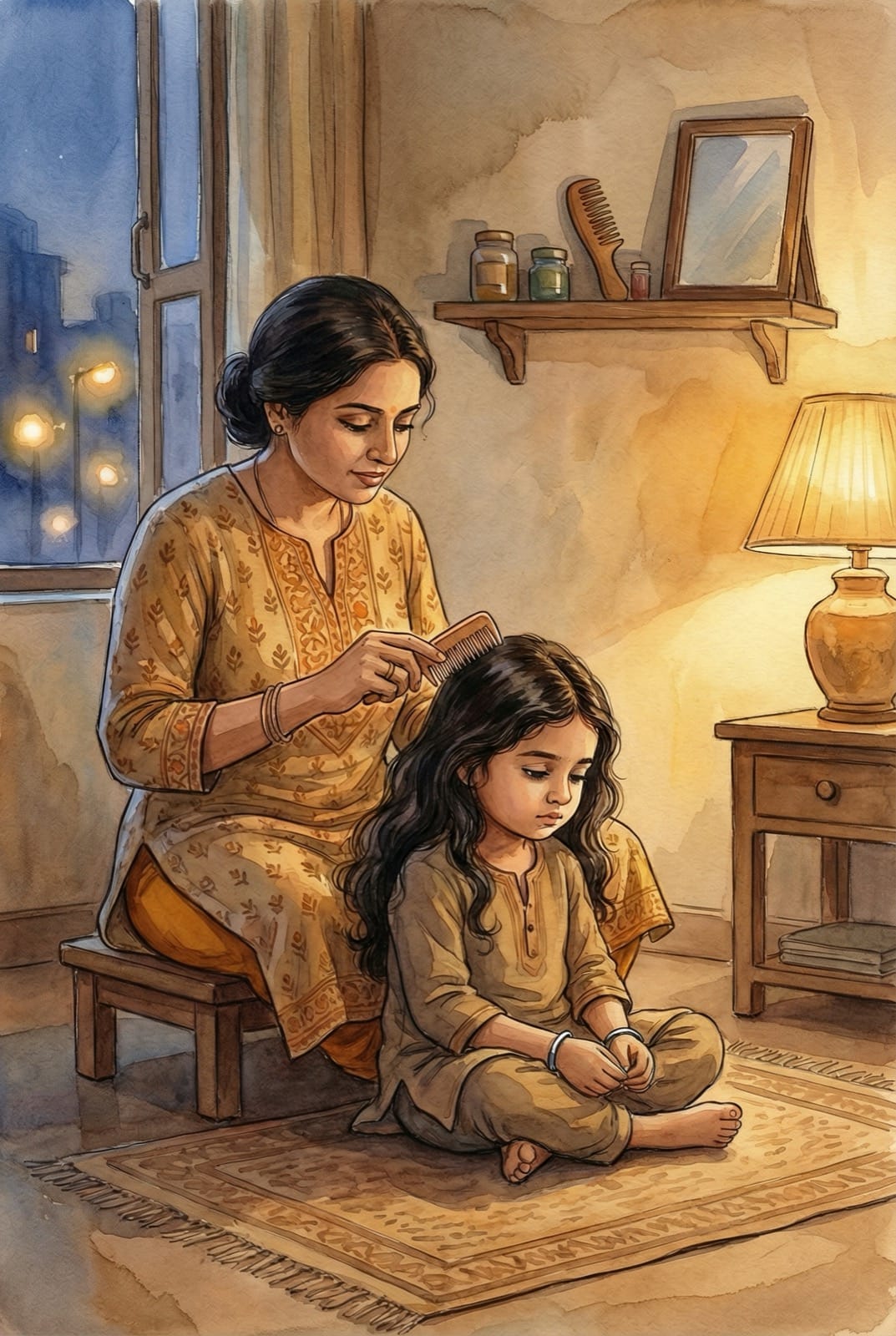
After dinner, Simran sat on the floor between her mum's knees. This was the part of the day that never changed. Morning and evening, the same.
Her mum reached for the kanga — the small wooden comb that lived on the shelf by the mirror. It was old and smooth. The teeth were rounded at the tips from years of use. Simran's nani had brought it from Amritsar, wrapped in a piece of soft cloth, and given it to her mum on her wedding day.
Her mum undid Simran's braid — slowly, starting at the bottom and working up, fingers loosening the twists before the comb went in. Then the kanga moved through Simran's hair, starting at the ends.
One stroke. Two. Three.
Simran usually counted out loud. Tonight she was quiet.
"Something happened," her mum said. It wasn't a question.
Simran said nothing.
The comb kept moving. Four. Five. Six. The teeth slid through, gentle and sure, and Simran felt the pull in her scalp — a feeling so familiar it was like breathing.
The Knot
On the seventh stroke, the comb stopped.
A knot. A real one — tight and tangled, near the back of Simran's head where her hair always caught against her backpack strap.
Her mum didn't pull. She never pulled. She set the comb down on her knee and used her fingers instead — working the edges of the tangle, finding where one strand crossed another, loosening it from the outside in.
"Maya showed me a drawing today," said Simran.
Her mum's fingers kept working. She didn't say anything.
"It was a drawing of the CN Tower. She's been working on it all week. She showed it to me at lunch."
The tangle loosened a little. Her mum picked up the comb again and tried the edges.
"The proportions were wrong," said Simran. "The observation deck was too high. I told her."
The comb caught again. Her mum set it back down and returned to her fingers.
"What did Maya say?" her mum asked quietly.
"Nothing. She just… closed the sketchbook. And she didn't open it again all afternoon."
Simran's throat felt tight. She could still see Maya's face — the way her expression folded inward, like a page turning.
"I wasn't wrong," Simran said. "The proportions were off."
"I know," said her mum. She worked another strand free.
"But I think I was unkind about it."
Her mum didn't say yes or no. She didn't say you should apologise or it'll be fine. She just kept working the knot — patient, careful, strand by strand. The room was quiet except for the hum of the fridge and the soft sound of hair being separated, gently, from itself.
Simran felt something loosen in her chest. Not all at once. Just a little.
"Maya's drawings are really good," she said. "She's the best artist I know."
"Mmm," said her mum.
"I should have said that first."
Her mum's fingers found the last crossed strand and eased it apart.
Smooth
The knot came free.
It didn't come free all at once. It loosened bit by bit, the way hard things do when you don't force them. One strand, then another, then the whole thing softened and the comb passed through like it had never been stuck.
Her mum combed the rest of Simran's hair — long, steady strokes from root to tip. The teeth of the kanga moved smoothly now. Simran could feel it in her scalp — the gentle pull, the release, the pull again. It was the most familiar feeling in the world.
"I think I'll draw something for Maya," said Simran. "Not a tower. Maybe a bridge. She loves drawing bridges."
"That sounds right," said her mum.
Simran counted the last few strokes. Twenty-nine. Thirty. Thirty-one.
Her mum braided her hair for the night — a loose braid, softer than the morning one — and set the kanga back on the shelf by the mirror, where it always lived.
Simran looked at it. Small, wooden, ordinary. It didn't do anything except what it was supposed to do. But it did that well.
"Mum?"
"Yes?"
"How do you always know where the knot starts?"
Her mum smiled. "You don't start where it's tightest. You start at the edges. You find what's loose and work your way in."
Simran thought about that. She thought about Maya's face, and the sketchbook closing, and the drawing of a bridge she would make tomorrow — not perfect, not precise, but made with care.
She went to her room. Outside, the streetlights blinked on one by one. She counted seven from her window before she pulled the curtain.
Seven streetlights. Twelve fridge magnets. One friend she needed to talk to.
Tomorrow, she would start at the edges.
The Bridge
In the morning, Simran sat between her mum's knees again. The kanga came off the shelf. The teeth moved through her hair — no knots today, just smooth, easy strokes.
"Thirty-five… thirty-six… thirty-seven," Simran counted.
Her mum braided her hair tight for school and set the kanga back on the shelf.
Simran put on her shoes, picked up her backpack, and slipped a piece of paper inside — a drawing she had made at the kitchen table while her dad cooked parathas. It was a bridge. Not the stone bridge from High Park or anything real. Just a bridge she had made up — a little wobbly, a little uneven, with a river underneath that was more scribble than water. It was not very good. She knew that. But she had drawn it carefully, and that was different from drawing it well.
She walked to school and counted the red doors (fourteen, same as always) and the cracks in the pavement (she lost count at nineteen — the big maple tree still threw her off). The air was cold and bright and her kara clinked against her lunchbox and the world felt like itself again.
At school, she found Maya sitting at her desk. The sketchbook was closed. Maya's hands were on top of it, flat, like she was keeping it shut on purpose.
Simran didn't start with sorry. She started at the edges.
"I drew something for you," she said, and held out the piece of paper.
Maya looked at it. She looked at it for a long time.
"That bridge is wonky," she said.
"I know," said Simran.
"The river looks like spaghetti."
"I know."
Maya's mouth twitched. Then she opened her sketchbook to a fresh page and put it between them on the desk.
"I'll show you how to draw water," she said. "If you want."
"Yes please," said Simran. "I would like that."
Discussion Questions
Let's Talk About It: Simran says she wasn't wrong about Maya's drawing, but she thinks she was unkind. Can you be right about something and still hurt someone's feelings? Has that ever happened to you?
Let's Think About It: Simran's mum doesn't tell her what to do. She just combs her hair. How does that help Simran figure things out on her own?
Let's Talk About It: Simran decides to draw a bridge for Maya — "not perfect, not precise, but made with care." Why does she choose something imperfect?
Let's Think About It: Simran's mum says you don't start where the knot is tightest — you start at the edges. Is that good advice for more than just hair?
Let's Try It: Next time you feel tangled up inside, try sitting quietly with someone you trust. You don't have to talk right away. Sometimes just being near someone helps you find the words.
Word Meanings
| Word | Meaning |
|---|---|
| Kanga | A small wooden comb used to care for hair — one of the five articles of Sikh identity |
| Puttar | Child — a term of love used by Punjabi parents |
| Nani | Grandmother (on your mother's side) — a term of love |
| Roti | Flatbread — a staple of Punjabi meals |
| Daal | Lentil stew — a staple of Punjabi meals |
About This Story
This story is the second in the Simran Kaur series — five stories set in Toronto, each woven around one of the Five Kakars (the five articles of Sikh identity given by Guru Gobind Singh Ji to the Khalsa in 1699). In this story, the Kanga — a small wooden comb used to care for hair — appears in its proper place: the daily hair care routine at home. The story does not explain the Kanga's significance. It shows a mother combing her daughter's hair with patience and care, and the space that simple act creates for a child to untangle her own feelings.
Explore More
- The Five Kakars — Articles of Sikh Faith — What the Five Kakars are and why they matter
- Simran Kaur and the Lost Sketchbook — The first story in the Five Kakars series
- Hair Twins — A picture book celebrating Sikh identity through hair
Available on Amazon
Bring this inspiring story into your home. Every copy sold helps us create more resources for Sikh children.
Free Coloring Sheet
A printable coloring page inspired by this story — great for after reading together.
Download PDF View all coloring sheets